
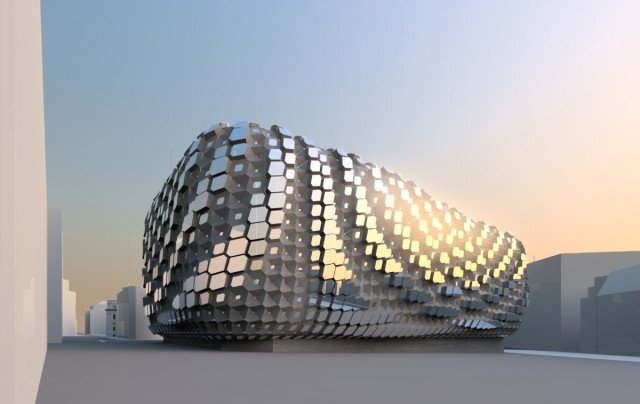
Parametric design and 3d printing workshop
Jawor Design Studio will run a special fast-paced and condensed parametric workshop that will be held in Poznań during Arena DesignFair , which will run from 5 to 8th of march 2013. The fair gathers all professionals and institutions related to design industry, including schools, universities, ,design offices and furniture makers. It will be focused on parametric and generative design techniques, and will utilize environments such as Rhino Grasshopper, Generative Components and Processing. We will be showing examples of algorithmically generated sculptures that will then be live-3d-printed on ZMorph 3d printers. You can find us in building 5, near to exit number 4. We’re starting at 12:00 on Thursday, the workshop will take 4 hours. If you want to participate, please fill this form.

Parametric design and Arduino – workshops in Nicosia, Cyprus

Between 19 and 24th of November 2012, Przemek Jaworski together with Michail Georgiou and Odysseas Georiou organized special set of workshops, focused on use of kinetic techniques and physical computing in architecture. Workshop participants learned how to use Arduino and Grasshopper environment to design, and prototype physical installations.
Workshops were divided into several blocks/topics. First day was introducing students into simple techniques of electronic actuation, triggered with the use of sensors (sound, light, temperature). ‘Hands-on’ examples were interwoven with short lectures and presentations.
On day two, students were split into four groups, each one coming up with unique design of an architectural, interactive piece.

First group was heavily inspired by Theo Jansen’s kinetic structures. Their prototype is a vehicle for water transportation in deserted areas, being driven mainly by light sensors and sun/shade balance. Equipped with three continuous rotation servo motors, it reacts to excessive sun exposure and directs its movement towards more shaded areas.
Second group focused on responsive acoustic surfaces, changing its geometry depending on level of decibels measured from environment in real time. Through manipulations of depth of special openings, the module is supposed to absorb excessive sound waves and decrease general room loudness. This kind of solution can be succesfully used for example in public exhibition spaces, where many simultaneous conversations happen at once and create audible noise (of course this would require entire set of such responsive panels to be deployed).
Third group integrated several factors related to weather sensing (humidity, temperature and sun exposure) to build a prototype of auto-adjustable roof module, which automatically regulates internal bio-climatic conditions.
The fourth group created special system for interactive wall that modifies visual occlusion of the outside, depending on movement of pedestrians or spectators. This is achieved by multiple cylinder openings that turn and twist a membrane inside, thus opening and closing the hole. Apart from modulating visual connection between both sides of the wall, it can also act as a ventilation mechanism.
The workshop succesfully promoted the idea of sustainable and reactive techniques helpful in creation of truly responsive, low-energy and eco-friendly architecture. We hope that for many of the participants, this is not an end, but just a beginning of a truly amazing journey (!)
Parametric and generative architecture – exhibition!
On Friday 7th of December together with LabDigiFab research group we’re planning to open an exhibition on computational architecture and digital fabrication techniques. The opening will take place in Oławska 21 street, in Headquarters of SARP (Society of Polish Architects), the vernissage starts at 7pm, everybody is welcome to attend!
Interactive installation with Kinect and movement sensing
Another prototype of interactive installation made with Processing. Particle spring system visualizes the speed of each particle by variable brightness, whilst moving towards physical objects sensed by Kinect 3d scanner.
Program works in two modes – at first particles are being repelled from moving persons, then moved towards them by magnetic attraction.
human-sensing particles from Przemek Jaworski on Vimeo.
Zmorph 3d printer development – chamber
Zmorph is evolving to next stage – now it’s being equipped with enclosure (chamber) that keeps the heat inside and prevents plastic from warping due to rapid cooling. Idea is now entering testing phase, we’re hoping that it will perform as expected. Keep your fingers crossed!
3d printing in large scale – experiment
Over course of summer Jawor Design Studio was involved in 3d printing of large scale spatial installation designed by Michał Piasecki and Mikołaj Molenda. In cooperation with Bolesław Telesiński and Piotrek Halczuk we built 6 Zmorph 3d printers and printed over 500 pieces made of ABS plastic. The installation will be opened this autumn in Warsaw, and will be fully video mapped, to create interactive audio-visual structure.
Mikołaj Molenda created a short movie about the process of printing, which will be later expanded to full documentary. Teaser attached below :
image courtesy of Mikołaj Molenda, all rights reserved
Some photos from the workshop :
More information about Zmorph 3d printers is available on http://zmorph3d.com/


